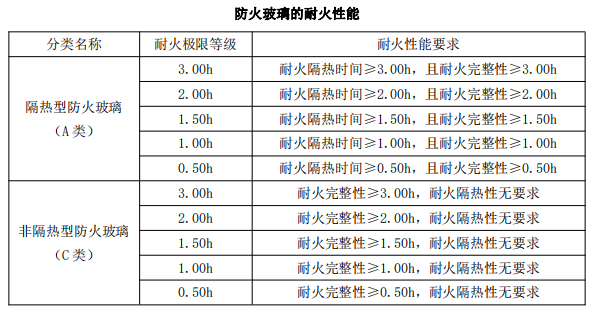
Fire-rated glass is a processed safety glazing designed to limit the spread of flame, smoke and heat for a defined fire resistance rating, expressed in minutes. It is evaluated against two criteria: integrity—the ability to prevent flame and hot gas penetration to the unexposed face—and insulation—the ability to keep the unexposed face below a specified temperature limit. Specifiers select either non-insulating (integrity-only, “E” class) or insulating (integrity plus insulation, “EI” class) products depending on the fire-compartment strategy.
Base substrates include float, coated and tempered glass. These are fabricated into monolithic or composite assemblies, which can also be assembled into insulating glass units (IGUs) for combined thermal and fire performance.
Monolithic fire-rated glass
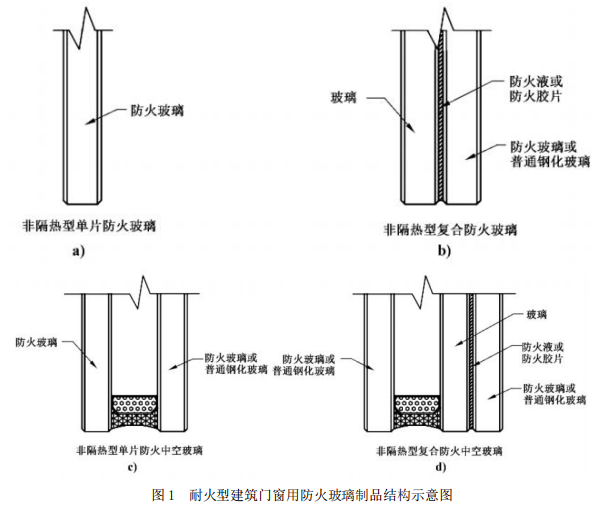
Monolithic non-insulating fire-rated glass is a single-layer product that meets integrity requirements.
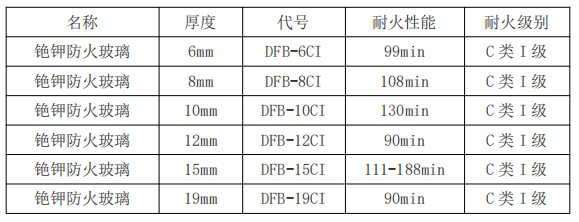
Caesium-potassium chemically tempered glass
This high-strength monolithic fire-rated glass is produced by an ion-exchange process lasting more than 20 hours at high temperature, in which sodium ions on the surface are replaced by larger caesium and potassium ions. This generates compressive stress and a low-expansion surface layer. The resulting product is stated to achieve 6–12 times the strength of annealed float glass and 1.5–3 times that of tempered glass. It remains transparent under UV and fire exposure and breaks into small granules. Drawbacks include a complex manufacturing process and potential chemical residues.
High-stress fire-rated glass
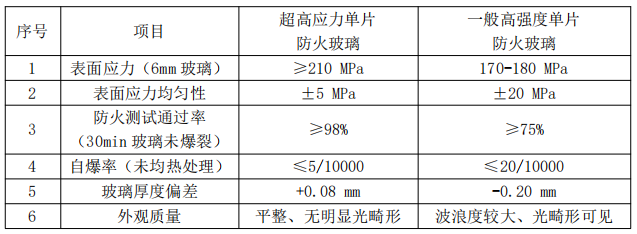
Manufactured in a dedicated fire-rated tempering furnace with controlled stress values and uniformity, this product is made by implanting low-expansion ions into a float glass substrate and bonding them via high-temperature catalysis to alter the thermal expansion coefficient. The manufacturer states that this forms stable microcrystalline clusters under heat, improving light transmittance and extending service life under fire conditions. The glass offers good transparency and production efficiency, but because soda-lime float glass has a softening point of roughly 600 °C, achieving extended fire resistance ratings in large dimensions is difficult. Frame and installation tolerances are also more demanding.
Borosilicate fire-rated glass
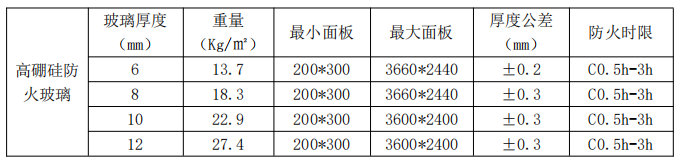
Produced from borosilicate substrate—roughly 80 % silicon dioxide, 14 % boron oxide and alumina, and 5 % alkali flux—and fully tempered, this glass has a thermal expansion coefficient roughly one-third that of standard soda-lime glass and a softening point of approximately 840 °C. It is rated for fire resistance up to 180 minutes and is compatible with water-sprinkler systems. The substrate is more than 8 % lighter than standard soda-lime glass and offers visible light transmittance (VLT) above 90 %. Before tempering it can be cut, drilled, edge-worked and coated; after tempering it can be laminated or fabricated into IGUs. Limitations include higher substrate cost and specialised equipment requirements.
Composite fire-rated glass
Composite fire-rated glass is built from two or more glass layers with interlayers or cavities to provide integrity and, in insulating types, thermal insulation.
Grouted laminated insulating fire-rated glass
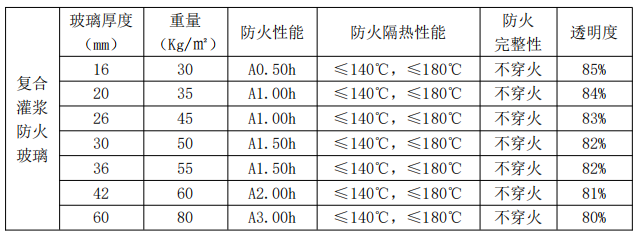
This “EI”-class product consists of two float glass lites with a cavity filled with a transparent fire-resistant gel. Under fire exposure the gel absorbs heat, foams and expands into an opaque layer that blocks conductive and radiative heat transfer. The assembly remains intact, forming a barrier against flame, smoke and hot toxic gases. A 120-minute rating typically requires a thickness of 35 mm or more. Prolonged solar exposure can cause the gel to yellow or blister.
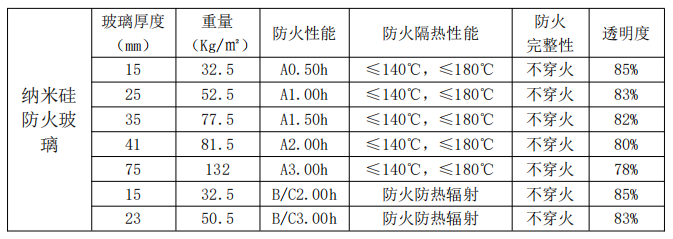
Nano-silica composite fire-rated glass
This product uses an inorganic expandable nano-silica fire gel between glass layers. Under fire conditions the gel foams, expands and carbonises into a low-thermal-conductivity layer that protects the unexposed face. Because the cured gel is an inorganic crystalline solid, the manufacturer states it resists weathering, discolouration and delamination under UV exposure. The laminated construction retains outer-lite fragments if breakage occurs, reducing fallout risk. The assembly provides insulation and is suitable for applications requiring long-term optical stability.