
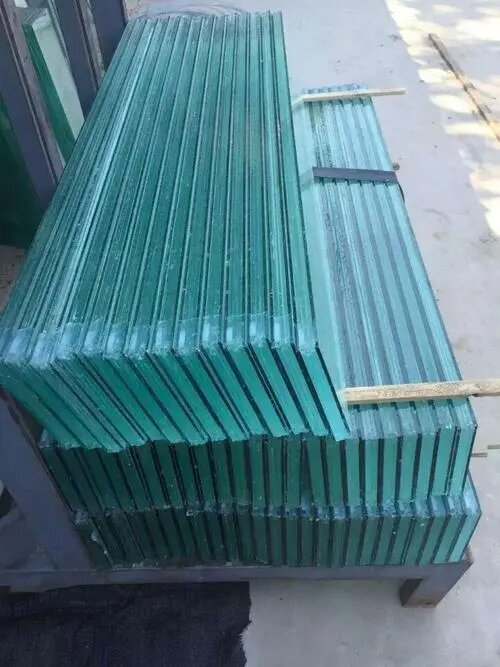
Composite fire-rated glass is produced by laminating two or more glass lites with intumescent interlayers—fire-resistant liquid or gel—to create an assembly that provides both integrity and thermal insulation. It is classified as laminated insulating fire-rated glass (“EI” class) under the A-class system, distinct from monolithic non-insulating fire-rated glass (integrity-only “E” class). Not all multi-lite or laminated assemblies qualify as insulating; laminated glass or insulating glass units (IGUs) without intumescent interlayers are treated as non-insulating (C-class) products regardless of multi-layer construction.
Performance Characteristics
During a fire, the intumescent interlayer expands to form an opaque thermal barrier while the glass maintains integrity. Assemblies are rated for fire resistance durations from 60 minutes to 180 minutes at flame temperatures around 1000 °C. Thickness typically exceeds 25 mm; builds of 25 mm, 35 mm, and 45 mm are commonly used to achieve 120-minute A-class ratings, with 30 mm also specified for certain insulating requirements. The mass of the assembly contributes to sound attenuation.
Product Variants
Grouted fire-rated glass: Manufactured by casting fire-resistant liquid between glass lites. The material expands under heat to block flames, smoke and radiant heat transfer.
Nano-silica composite fire-rated glass: Incorporates a nano-silica interlayer that offers high-temperature resistance and high visible light transmittance, suitable for fire-rated curtain walls and interior partitions.
Specification and Application Notes
To achieve the declared fire-resistance rating, composite insulating assemblies must be installed with full steel frames, fire-rated hardware and intumescent seals. The fire-resistant performance is time-limited and degrades with age; building operation plans should include replacement and maintenance schedules.