
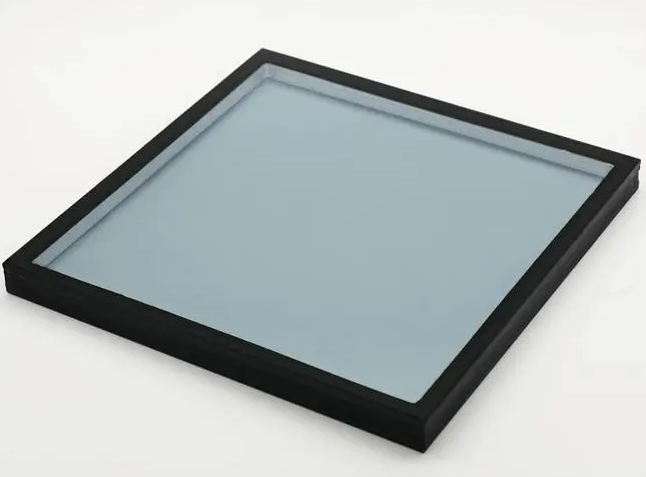
Insulating glass units (IGUs) and fire-rated glass serve distinct functions in a building envelope. An IGU comprises two or more glass lites separated by a sealed, gas-filled cavity. It is specified to improve thermal performance and reduce heat transfer, but a standard IGU does not provide a fire-resistance rating.
Fire-rated glass is engineered to maintain integrity—limiting the passage of flame and smoke—for a defined fire resistance rating expressed in minutes. Products rated for insulation (EI class) also restrict temperature rise on the non-fire side. These assemblies undergo furnace testing to verify integrity and, where applicable, insulation performance. Typical applications include fire compartments, egress corridors, and stairwell enclosures.
The product range includes monolithic non-insulating fire-rated glass (integrity-only, E class) and laminated insulating fire-rated glass (EI class), which uses intumescent interlayers that expand under heat exposure to block thermal transfer. Fire-rated glass can be fabricated into IGUs where both thermal performance and fire resistance are required, but the fire rating applies to the complete assembly, including framing and seals, not to the IGU alone.

Selection should therefore be driven by code requirements: specify IGUs for energy efficiency, and specify tested fire-rated glazing assemblies where fire compartmentation is required.