
Sichuan Xionggang Glass operates a 70,000 m² fabrication plant in Southwest China. The site employs more than 300 people—approximately 70 per cent technical staff—and processes over 3.5 million m² of glass annually. Equipment includes five Italian automatic cutting lines, eight automatic edging machines, one automatic high-stress cyclic tempering furnace for monolithic non-insulating fire-rated glass, one laminated non-insulating fire-rated glass line, three automatic double-chamber tempering furnaces with curved tempered glass capability, two laminated-glass lines, six imported insulating glass unit lines, one ceramic frit glass line and a heat-soak furnace.
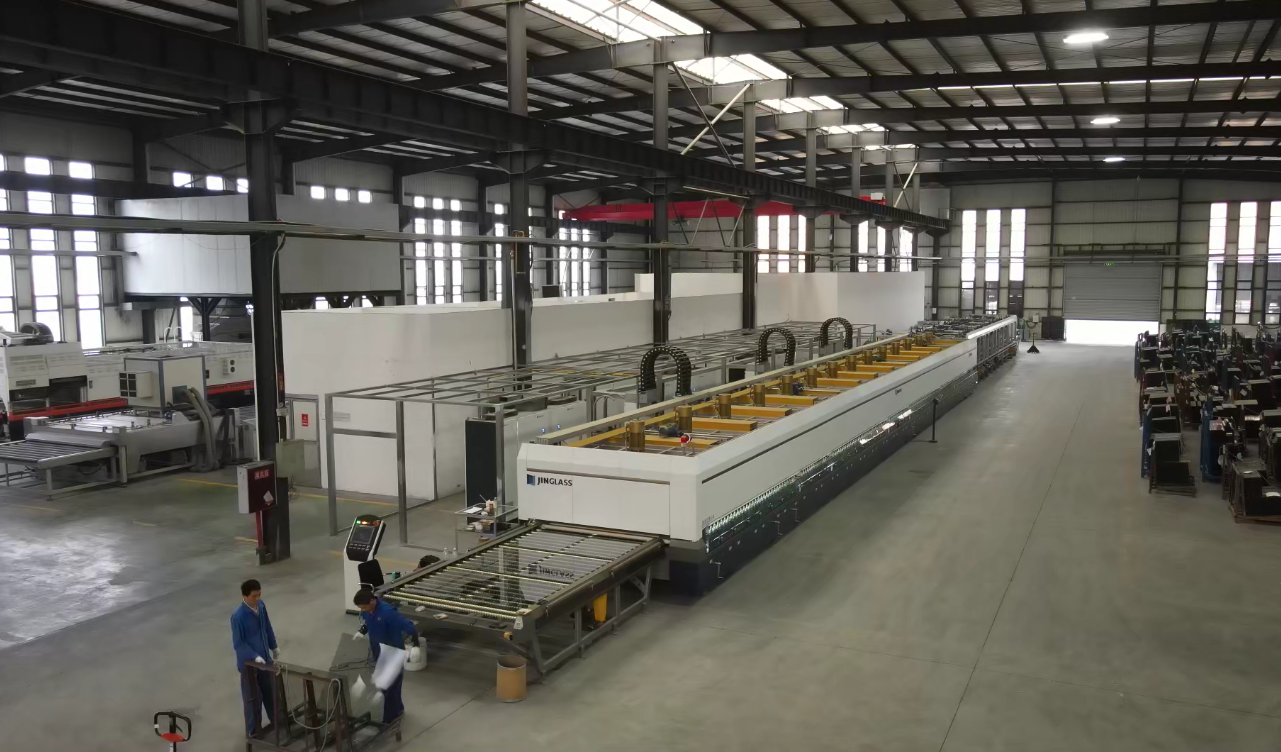
The continuous tempering line uses a matrix mid-infrared forced-convection system. Glass travels in one direction without reciprocating, which the company credits with uniform stress, light stress pattern, good optical quality, low spontaneous-breakage rates and lower energy use. The furnace handles soda-lime-silica and borosilicate fire-rated glass, ordinary float glass, and single-, double- and triple-silver Low-E coated glass in fully tempered or heat-strengthened form. Xionggang states that 50 mm × 50 mm fully tempered fire-rated glass yields 40–90 fragments at stress values of 90–110 MPa.
Its fire-rated range includes borosilicate, high-strength monolithic and nano-silica composite types.
Borosilicate fire-rated glass is offered in sheets up to 4500 mm × 2440 mm and 5 mm to 15 mm thick, with custom dimensions available.
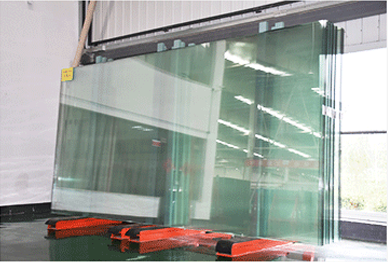
High-strength monolithic fire-rated glass is tempered to 180–230 MPa and carries a fire-resistance rating above 1.00 h. Xionggang markets it for fire doors, fire windows, smoke curtains and fire partitions in public buildings.
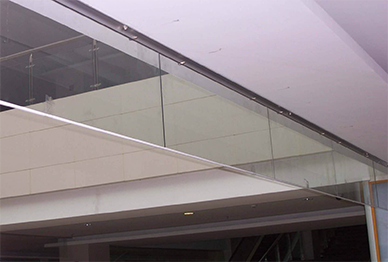
Nano-silica composite fire-rated glass can be supplied as an EI-class insulating or non-insulating unit in rectangular, square or circular formats. The company states the product requires 30 process steps and 500 hours to produce. Integrity ratings are listed at 0.5 h, 1.00 h, 1.50 h, 2.00 h and 3.00 h. The design is intended to prevent the outer pane from shattering outward, eliminating explosion risk.

Xionggang maintains an in-house fire-glass burn-test centre for random, unscheduled repeated sampling. The company reports that production lots consistently meet the relevant fire-resistance and thermal-insulation requirements.